CFA de Livron, Drôme, France
Dual training in service and cuisine
He earns his CAP/BEP in restaurant service in 1985, followed a year later by a CAP/BEP in cuisine at the CFA de Livron — two formal qualifications, in two different trades.
From a first cooking apprenticeship in the French Antilles to nearly four decades behind the world's finest wine lists — a chronology built from certificates, press archives, and the sommelier's own record.
He earns his CAP/BEP in restaurant service in 1985, followed a year later by a CAP/BEP in cuisine at the CFA de Livron — two formal qualifications, in two different trades.
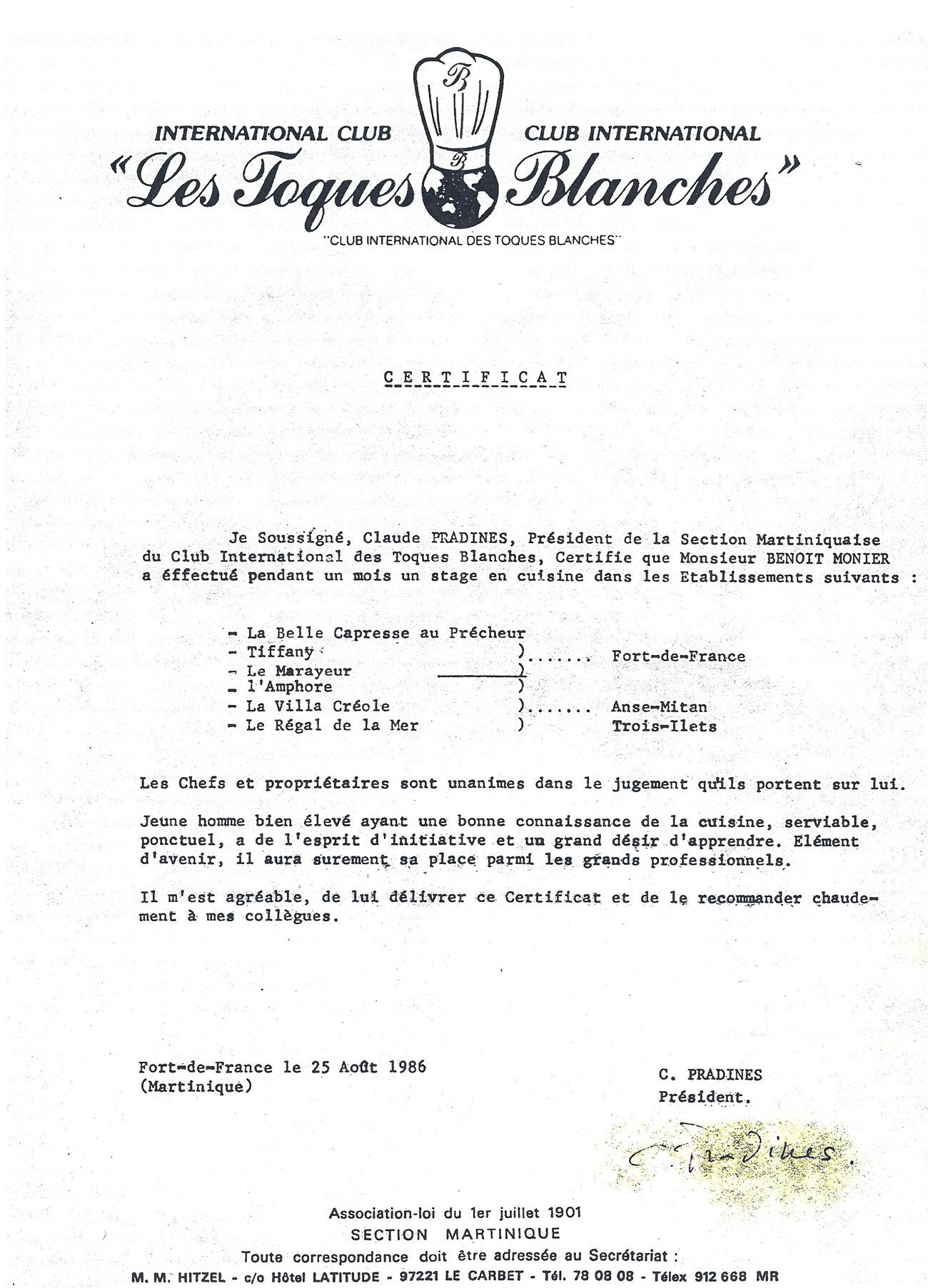
He completes a month-long kitchen stage across six restaurants in Martinique, certified by the association Les Toques Blanches — his first hard evidence of hands-on cooking, years before he ever poured a glass of wine professionally.
His sommellerie career begins as an assistant at Roger Vergé's celebrated Le Moulin de Mougins, one of the temples of Provençal haute cuisine.
He trains briefly as an oenology technician at the Cave Coopérative of Tain-l'Hermitage and completes his sommellerie studies at the town's hotel school — the exact point where his culinary and wine educations intersect.
He works as sommelier with the three-Michelin-starred chef Jacques Pic in Valence, who personally signs his certificate of employment praising his talent — a rare, tangible endorsement from one of French gastronomy's defining chefs.
Before returning to France, he spends three months not behind a wine list but running a kitchen outright, as chef at The Tythe Barn Inn in Yorkshire — purchasing, prep, cooking, staff, and hygiene all under his charge.
In 1990 he sits the professional culinary diploma of Ferrandi Paris — the school long nicknamed "the Harvard of gastronomy" — as a candidat libre, an external candidate who prepares independently rather than attending full-time. He passes without ever being a conventional enrolled student, a detail that says as much about his self-taught discipline as any classroom would.
He becomes head sommelier at Michel Rochedy's Le Chabichou in Saint-Tropez, his first title as chef sommelier.
He joins the cellar of René Durand's Maison Blanche on Avenue Montaigne, in the heart of Paris's haute couture district.
He takes charge of the cellar alongside Michel Guérard, one of the founding fathers of nouvelle cuisine, splitting his time between Les Prés d'Eugénie and the Château de Bachen — a period during which the trade press already singles him out by name as "the young sommelier" decanting the estate's own wine.
As head sommelier of Roland Durand's two-Michelin-starred Le Pré Catelan in the Bois de Boulogne, he builds a cellar that wins the Champagne Gosset trophy for best wine list in 1996 — and, a year earlier, steps out from behind the bottle himself, partnering with chef Olivier Brulard to win third prize at a national food-and-wine pairing competition.
Jean-Claude Vrinat, the legendary owner of Taillevent in Paris, personally recruits him to Tokyo, where he manages a cellar of nearly 100,000 bottles a year at Château Restaurant Taillevent-Robuchon — his first sustained collaboration with the Robuchon house — while also teaching French wine courses at the Institut franco-japonais de Tokyo.
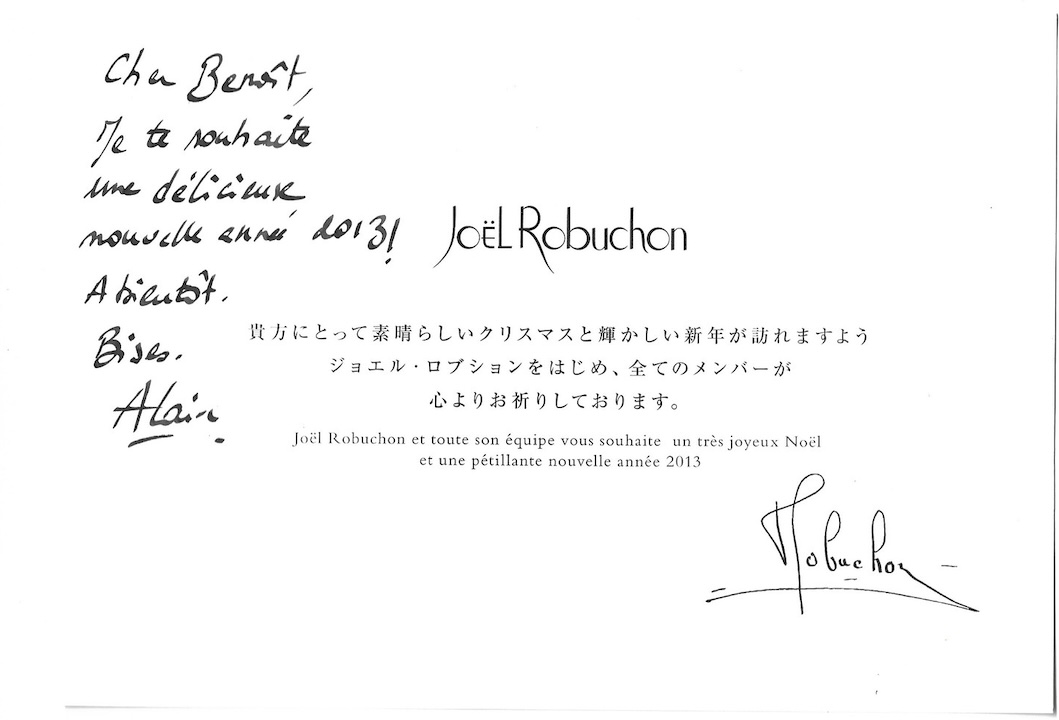
He moves between several of Joël Robuchon's restaurants worldwide, from Monaco to Paris to Las Vegas, deepening a relationship with the Robuchon group that will define the next two decades — a bond later marked by personal keepsakes like a handwritten New Year card from Robuchon himself.
He joins L'Atelier et Le Jardin de Joël Robuchon in Hong Kong, continuing to build his reputation across Asia's fine-dining scene.
Since the Taipei restaurant's opening in July 2010, Benoît Monier has served as its senior sommelier — recognized by the Michelin Guide as "an authority in French wines," and, as of this writing, still at his post after more than fifteen years.